Trump’s falling popularity hangs over a midterm vote shaped by Iran war, inflation
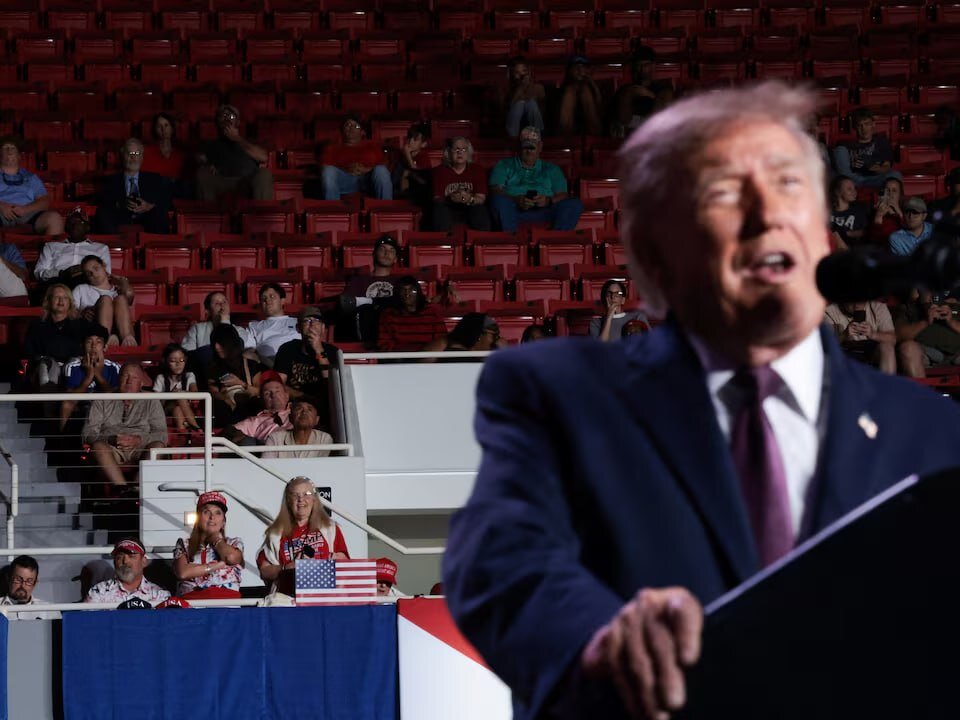
TEHRAN — Donald Trump is not on the ballot, yet the election is about little else. On November 3, roughly 210 million registered voters will decide all 435 House seats, 35 Senate seats and 36 governorships.
Their verdict on the war on Iran, inflation and the campaign his party has run will determine how much power Trump keeps for the last two years of his term.
A Reuters/Ipsos poll completed on October 26 put Trump’s approval at 32 percent, one point above the record low set a week earlier. Registered voters preferred Democrats on the congressional ballot, 47 percent to 36 percent. Counting undecided voters who lean toward a party, the gap is 50 to 41.
History offers Republicans little comfort. Since 1946, the president’s party has lost an average of 26.5 House seats in midterms. No president has entered midterm election so unpopular since Harry Truman, and Trump sits nearly 10 points below where he stood in 2018, when Republicans still held onto several Senate seats in friendly territory.
Democrats need a net gain of three seats for the House. The Senate is a steeper climb. Republicans hold 53 seats, Democrats and their two independent allies hold 47, and a 50-50 split would still favor Republicans because Vice President JD Vance breaks ties. Democrats need four seats, and many of the contests lie in states Trump won comfortably two years ago.
The price problem
Prices are the one issue Trump promised to fix. In 2024 he vowed to “rapidly bring down costs.” Since then, they have outrun wages, and households feel it in gasoline, groceries, insurance premiums, rent, mortgages and credit-card balances.
The White House answers with “growth” figures. Output rose at a 3.4 percent annual rate over the summer, and consumer spending climbed 3.8 percent in the third quarter. Voters are unmoved.
National Economic Council Director Kevin Hassett has called worries about affordability a “myth,” and Trump has called the issue a “hoax.” At a rally in Lubbock, he insisted prices had fallen while signs in the crowd demanded “LOWER PRICES.”
Gasoline costs more than $1 a gallon above its level on the day Trump returned to office, according to AAA. Tariffs, tax cuts that pushed the federal debt past $40 trillion, and cuts to food and health benefits have added to the strain.
The war on Iran added more. The blockade and attacks around the Strait of Hormuz lifted oil prices and, with them, the cost of farming, trucking, heating and shipping. About 73 percent of Americans say they are extremely or very concerned about fuel prices driven by the war.
The Iran war quagmire
Nearly two-thirds of Americans oppose U.S. involvement in the war on Iran, and the aggressive campaign has split both parties. The fighting has hardened into an open-ended confrontation with no political settlement in sight.
At least 21 U.S. service members have died and more than 800 have been wounded. Iranian missiles and drones have damaged American bases, including Al Udeid in Qatar. Even so, the Pentagon blocked Senator Chris Murphy from visiting the base on a fact-finding trip.
“War” Secretary Pete Hegseth, who helped lead the campaign, has run the department with secrecy, purges of senior officers and open hostility toward Congress.
Democrats are preparing to answer in kind. Minority Leader Hakeem Jeffries has promised to “run Pete Hegseth out of town” if his party wins the House.
A Politico poll found 63 percent of Democratic midterm voters support impeaching him, and Republican Representative Thomas Massie has already filed eight articles accusing Hegseth of plotting an illegal war and obstructing oversight.
Conviction in the Senate is unlikely. Hearings would still put the legal and human cost of a war Trump never asked Congress to authorize on the public record.
Campaigning on fear
Candidates who cannot run on prices or the war have found another subject. In Michigan, Trump and his allies have turned the Senate race against Democrat Abdul El-Sayed into a sustained attack on Muslims.
Trump has mocked El-Sayed’s name, called him a “jihadist” and suggested he should pass through a metal detector before entering the Capitol. Republican nominee Mike Rogers has baselessly tied him to Hamas, Hezbollah, Iran and the Muslim Brotherhood.
The rhetoric has gone mainstream within the GOP. Health Secretary Robert F. Kennedy Jr. claimed “Arabs do not produce literature or science and do not win Nobel Prizes.” Senator Ted Cruz called El-Sayed a “jihadist leprechaun.”
Dearborn Mayor Abdullah Hammoud says his city receives daily threats, and Muslim advocates describe a climate worse than the weeks after September 11.
Ohio supplied a different kind of ugliness. Vivek Ramaswamy promoted an advertisement featuring the estranged birth mother of Democratic gubernatorial candidate Amy Acton, using her childhood abuse and homelessness to suggest instability.
Republican Governor Mike DeWine asked for it to come down. Trump and Vance defended it. Campaigning in the Midwest, Barack Obama called the approach “cruelty” and “indecency.”
Billionaires bankrolling
Money is meant to do the work persuasion cannot. Elon Musk has given more than $445 million to federal political committees this cycle, the largest disclosed donation total in modern midterm history.
He put $77 million into America PAC in the first half of October and $158 million into the Senate Leadership Fund in September, aimed at the Senate seats Republicans must hold.
He has company. Public Citizen reports that 515 donors giving at least $1 million have supplied $4.2 billion to super PACs in 2026, with Musk alone responsible for about 10 percent. Trump-aligned committees and Republican congressional super PACs raised $2.1 billion through the third quarter, against $1.3 billion for Democratic groups.
Spending on that scale reads as an attempt to buy protection, taken out on an unpopular president, an unpopular war and a message built on scapegoats.
After November comes the fight over inheritance. Who will carry a failing GOP?
Leave a Comment